Generator Sizing Guide
How to calculate your wattage needs and choose the right size generator.
How to calculate your wattage needs and choose the right size generator.
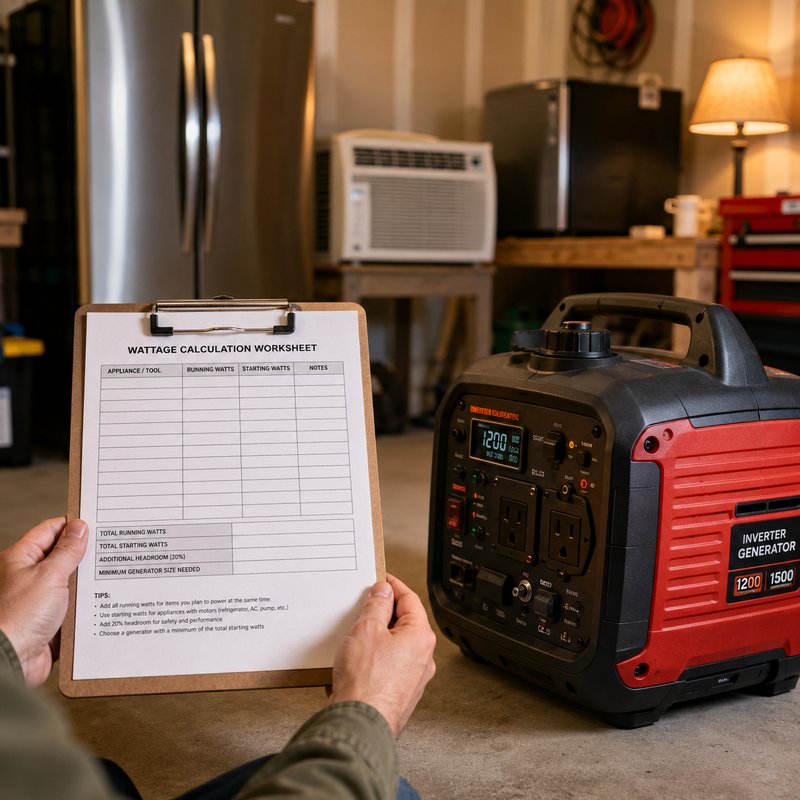
Every appliance has two wattage ratings: running watts (the continuous draw during normal operation) and starting watts (the brief surge needed when a motor kicks on). Your generator must handle the combined running watts of everything you want to power simultaneously, plus the highest single starting-watt spike.
The general rule: add up your running watts, then add 20% headroom for safety and performance. Your generator’s rated (running) wattage should meet or exceed that number.
| Appliance | Running Watts | Starting Watts |
|---|---|---|
| Refrigerator | 150–400 | 1,200 |
| Window AC (10,000 BTU) | 1,200 | 3,600 |
| Central AC (3-ton) | 3,500 | 7,000 |
| Sump Pump (1/2 HP) | 800 | 2,000 |
| Well Pump (1/2 HP) | 1,000 | 2,100 |
| Microwave (1,000W) | 1,000 | 1,500 |
| Electric Range (single burner) | 1,500 | 1,500 |
| Space Heater | 1,500 | 1,500 |
| LED Lights (per bulb) | 10 | 10 |
| Phone Charger | 5–25 | 5–25 |
| Laptop | 50–100 | 50–100 |
| TV (50″ LED) | 80–120 | 80–120 |
| Circular Saw | 1,400 | 2,300 |
| Air Compressor (1 HP) | 1,600 | 4,500 |
| RV Air Conditioner (15k BTU) | 1,800 | 3,500 |
| CPAP Machine | 30–60 | 30–60 |
Camping & Tailgating (1,000–2,500W): Phone chargers, LED lights, a small cooler, and a laptop. A compact inverter like the Honda EU2200i or WEN 56200i handles this easily with hours of quiet runtime.
RV Power (3,000–4,500W): RV air conditioner, TV, lights, phone chargers, and a microwave. A mid-range inverter or dual-fuel unit like the Westinghouse iGen4500DF or WEN 56380i covers the load with the 30A RV outlet you need.
Home Emergency Backup (5,000–12,000W): Refrigerator, well pump, sump pump, lights, furnace fan, a window AC, and a few outlets. A large dual-fuel unit like the DuroMax XP12000EH or a whole-house standby covers the critical circuits.
Whole-House (14,000W+): Everything including central AC. This is home standby territory — the Generac Guardian 24kW with an automatic transfer switch keeps every circuit live without manual intervention.
Inverter generators produce clean sine-wave power (under 3% THD), making them safe for laptops, phones, and sensitive electronics. They run quieter and more efficiently by adjusting engine speed to the load. Best for: camping, RVs, tailgating, and light home backup.
Conventional portable generators are louder and less fuel-efficient, but deliver higher raw wattage per dollar. They produce rougher power that can damage sensitive electronics. Best for: jobsites and heavy-duty loads where noise isn’t a concern.
Home standby generators are permanently installed, connected to your natural gas or propane line, and turn on automatically within seconds of a power outage. Best for: homeowners who want seamless, hands-off whole-house backup.
Gasoline: Most widely available. Shelf life of 3–6 months (12+ months with stabilizer). Produces the highest peak output per engine size.
Propane (LP): Stores indefinitely in sealed tanks. Burns cleaner with less maintenance. Slightly lower output per gallon vs. gasoline. Many campgrounds and hardware stores stock 20 lb tanks.
Dual-Fuel: Runs on either gas or propane. Gives you fuel-source redundancy — if gas stations are down after a storm, propane tanks from your grill still work.
Solar / Battery: Zero emissions, silent operation, no fuel needed. Charges from wall outlet, solar panels, or car. Limited by battery capacity; best for moderate loads and environments where noise or exhaust is unacceptable.
Natural Gas: Standby generators connect directly to your home’s gas line for unlimited fuel supply. No refueling, no storage. Available only for permanent installations.
Ready to browse? Start with the category that matches your use case: